


A roof buried under mature canopy is the job where most contractors stop trusting remote measurement. The imagery shows leaves, the report comes back with numbers nobody can verify from the picture, and climbing starts to feel like the safer option. It isn't a satellite problem. It's a date problem. The roof under those trees has been photographed clearly at some point, and the work is finding that view and confirming the roof hasn't changed since.
Why do trees make aerial roof measurements inaccurate?
Because leaves cover the edges, and the edges are the measurement. Full summer foliage tends to sit over eaves, hips, valleys, and gables, which are the features that drive squares, linear footage, and waste. The middle of the roof is usually visible. The perimeter and the transitions are what disappear, and those are the numbers you're ordering material against.
That's why a report on a shaded property can look clean and still be wrong. A missing dormer or a valley read as a straight run doesn't announce itself on the page. It shows up when the crew is on site and the material order is short, or when a change order has to go back to the homeowner. This is the same accuracy problem that separates one aerial roof measurement provider from another. In heavily wooded markets, that risk is why a lot of contractors stopped ordering remote measurements at all and went back to climbing.
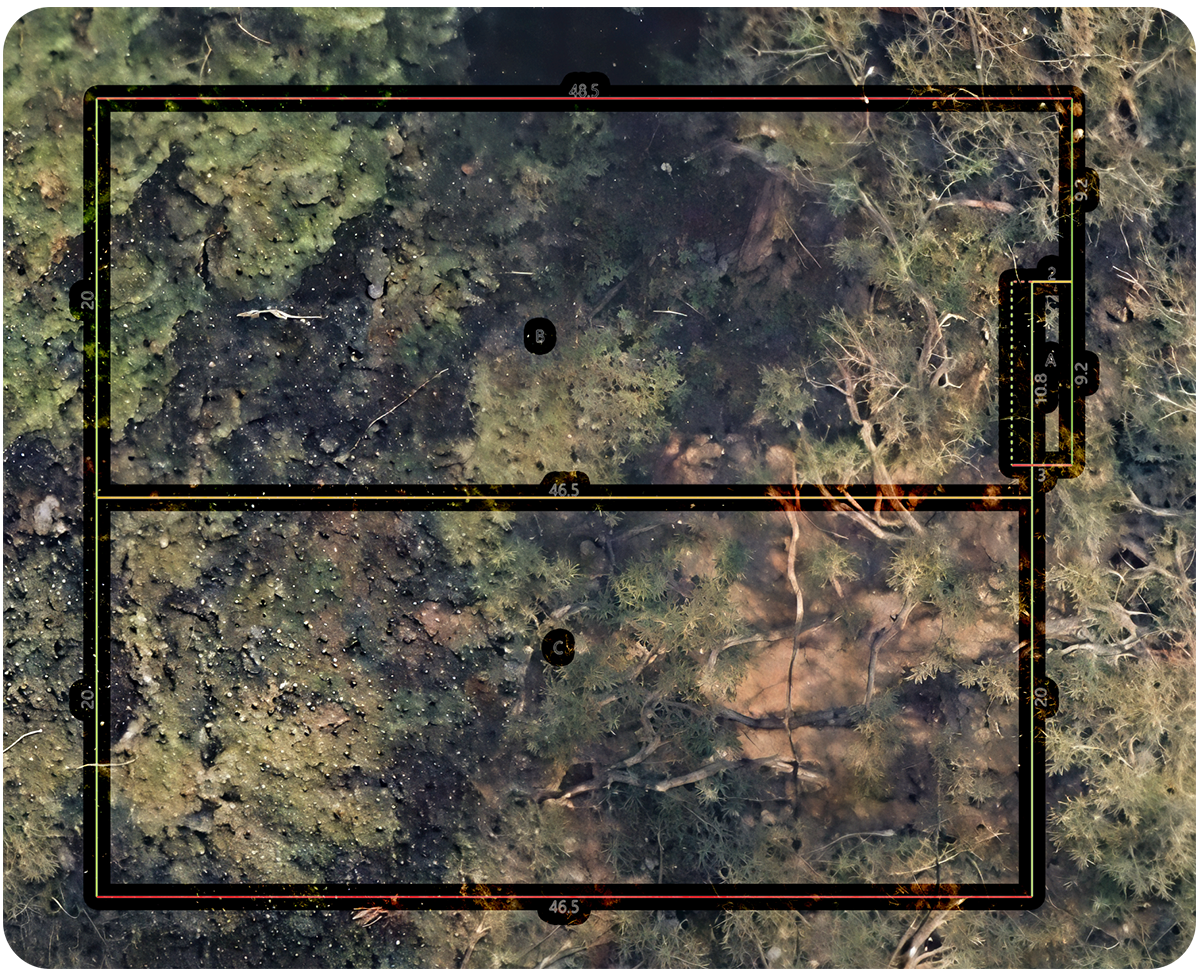
Can a roof be measured if trees cover it?
In most cases, yes, because the roof wasn't always covered. Canopy changes. Trees lose their leaves, they get trimmed, they come down in storms, and ten years ago they were smaller. The roof underneath has been photographed clearly at some point, usually more than once.
So the work isn't finding a better photo of today. It's finding the right date. We pull from multiple imagery sources across a range of years and select the view that actually shows the roof, which is often autumn or winter, and sometimes several years back.
There's no fixed lookback window. We don't stop at two years or five. We go back as far as we need to and as far as the available imagery allows, because the goal is a clear view of the roof rather than a recent one. On a difficult property that can mean reviewing a lot of imagery before anyone draws a line. It's one of the things worth asking about when you're choosing a measurement provider.
Older imagery only works if someone asks what changed
So we ask. An image from six years ago is only useful if the roof in that image is the roof standing there today, and that isn't something anyone can tell by looking at the image. A dormer added in 2022 doesn't appear in a 2019 photo. Neither does an addition off the back, a detached garage, or a re-roof that changed the pitch.
This is the part that turns old imagery from a shortcut into a method. When we're working from an older view, we ask about additions or changes in that window, so the measurement reflects the current structure instead of an assumption about it. Your answer takes a few seconds and it's the difference between a report that's historically accurate and a report that's accurate.
If you know the house has changed since it was last clearly photographed, tell us up front. It's the single most useful thing you can hand us on a tree-covered property.
Who decides which imagery gets used on your order?
A person does, and which person depends on how you order. If you're working with our Client Services team, the imagery approach gets decided during that conversation, while the address and any known changes are in front of them. If you place the order yourself, the CAD team makes the call when the report is built.
Either way, somebody is looking at your specific address and choosing the source that shows that specific roof. It isn't a default setting applied to every order in the queue. Properties in wooded or rural markets get the same attention as anything else, and the harder the property, the more imagery gets reviewed before the drawing starts.
Every report is drawn and verified by a CAD technician, which is also why the imagery question gets asked in the first place. Somebody has to decide what they're looking at.
Do you have to send photos of the roof?
Usually not, and that's deliberate. We ask for photos only when they're genuinely necessary and when getting them isn't a lift for you.
The reason is simple. If a measurement provider asks you to get up on the roof and document it, you've lost the reason you ordered a report. The same goes for asking you to call a homeowner and request photos, which puts you in an awkward conversation to solve a problem that isn't yours. Photo requests that pile up turn a service into homework.
When we do ask, it's usually narrow: one angle of one section, or a look at something on the ground that settles a question the imagery left open. If a request would take you more than a couple of minutes, it probably shouldn't be a request.
What happens if a provider can't measure your roof?
You find out before you've priced the job instead of after. Across all properties and conditions, our decline-to-measure rate is under 1%, so this is rare, but it isn't zero and pretending otherwise would be worse than saying so.
The timing is what matters here. A decline that reaches you the same day costs you an hour of planning. A report that quietly guesses at a covered section costs you the material order, the crew day, and the conversation with the homeowner about why the number moved.
If a property genuinely can't be measured from the available imagery, the answer comes back as a decline rather than a guess. Saying so is part of the process, and it's the reason the rate stays where it is.
What should you send when a roof is hard to see?
Three things, and most orders only need the first.
- 1The address.Complete and correct, including the unit number if there is one.
- 2Any changes you know about, and roughly when.Additions, dormers, a detached structure, a re-roof that changed the shape. Approximate timing is fine.
- 3Photos, only if we ask.We'll tell you exactly what we need and it should be quick.
That's the whole list. You don't need to pre-screen the property, check whether the trees are too thick, or decide in advance whether the job is measurable. That's the part we handle.
Common questions
Does using older imagery affect the 99% accuracy guarantee?
No. The guarantee applies to every report regardless of which imagery date the report was built from. The date is chosen because it shows the roof clearly, and the measurement is drawn and verified either way.
Does tree cover cost more to measure?
No. Pricing is set by report type, not by how difficult the property is to see.
Do I need a drone for a tree-covered roof?
Usually not. Most canopy problems are solved by looking at a different imagery date rather than by capturing a new image.
Stop climbing the wooded jobs
Tree cover is the condition contractors assume will break a remote measurement, and it's a solved problem most of the time. It gets solved by looking at a different date and by asking you one question about what's changed since.
If you've been climbing wooded properties because the last report you got on one was wrong, send us the next one and see what comes back.
Start an order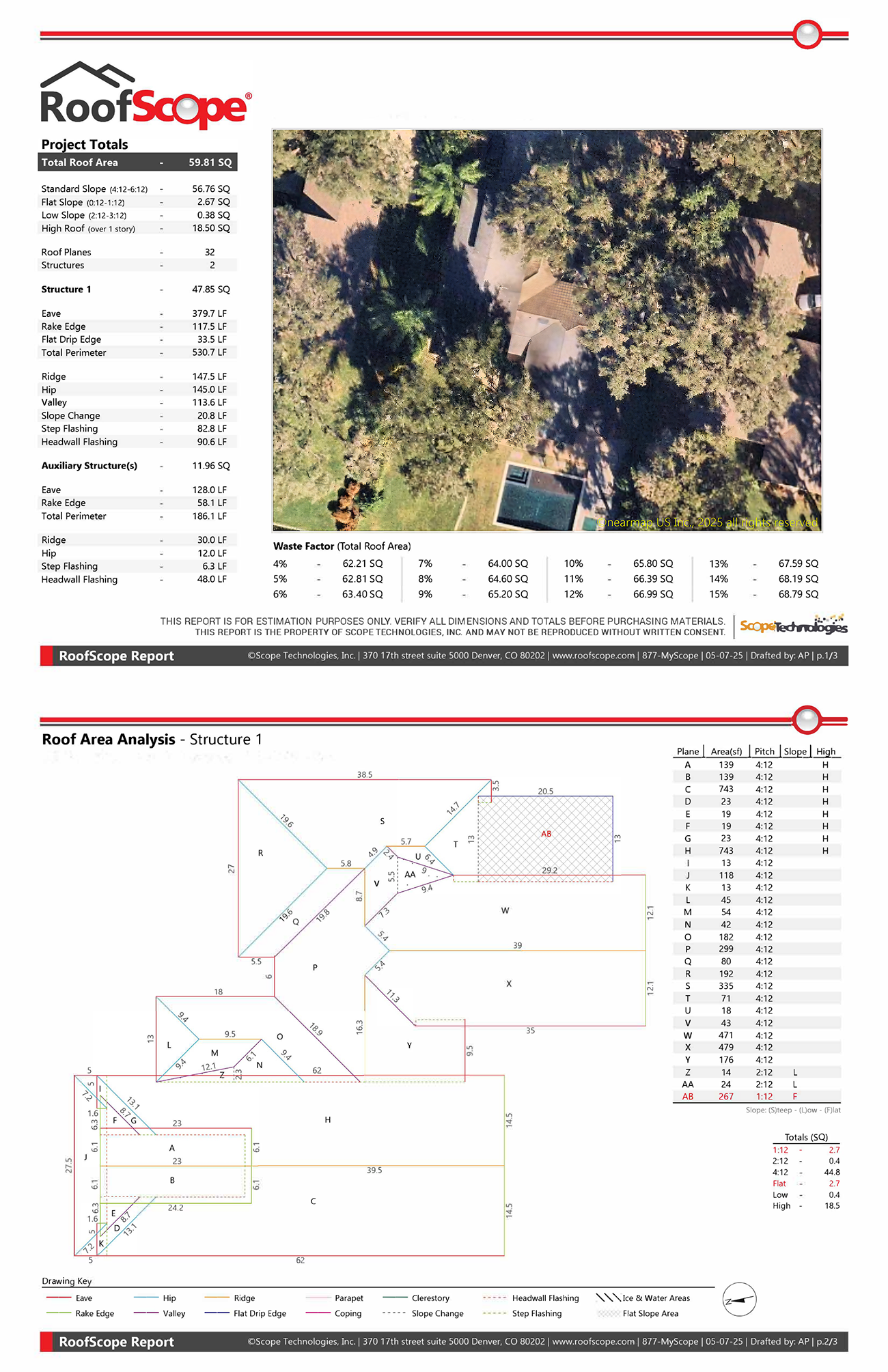
written by RoofScope published on 09. 17. 2026