


Most roof material orders start the same way. Take the squares, multiply by three bundles, add 10 to 15% for waste, and round up. It's the method nearly every guide teaches, and for shingles on a simple roof it gets you close.
The trouble is everything else on the order. Starter, cap, drip edge, flashing, ridge vent, and ice and water barrier aren't sized from squares at all. They come from linear feet or a specific area, and each one converts to its own purchase unit. Put one waste percentage across all of them and the quantities you order drift away from the roof you measured, some lines more than others.
What is a roofing waste factor?
A waste factor is the percentage you add to a measured quantity to cover cutoffs, overlap, and material damaged on the job. The common convention on a standard shingle roof is 10 to 15%, with more on roofs cut up by hips, valleys, and dormers.
It sits on top of a square count. A roofing square is 100 square feet of roof surface, so a 2,500 square foot roof is 25 squares before waste.
How much of a roof order comes from the square count?
Scope's ProDocs conversion reference lists 17 standard line items for a pitched shingle roof. Only 3 of them are sized straight from the total square count: decking, the nails that hold it, and pipe jacks.
The other 14 break down like this:
- 8 come from linear feet: starter strip, hip and ridge cap, eave drip edge, rake drip edge, step flashing, L flashing, valley flashing, and ridge vent.
- 5 come from the sloped roof area, which is the total minus any flat sections: shingles, coil nails, felt, cap nails, and slant-back vents. Felt counts the low-slope area twice.
- 1 comes from the ice and water barrier area.
That's our reading of our own reference, and it doesn't describe how every shop builds an order. But the split doesn't depend on the roof. Starter is sized from the eaves and rakes whatever the square count says, and so is drip edge.
Which measurement sizes each material?
Each accessory has one driver. Get that measurement right and convert it to the unit your supplier sells.
| Measurement | Materials it sizes | Default purchase unit |
|---|---|---|
| Eave | Starter strip (with rake), 2" x 4" drip edge | 105 LF per bundle; 10 LF per stick |
| Rake | Starter strip (with eave), D-style drip edge | 105 LF per bundle; 10 LF per piece |
| Hip and ridge | Hip and ridge cap | 33 LF per bundle |
| Ridge | Ridge vent | 20 or 30 LF per roll, by manufacturer |
| Valley | W flashing | 10 LF per stick |
| Step flashing (roof to wall) | 8" x 8" step flashing | 30 LF per bundle |
| Headwall | L flashing | 10 LF per piece |
| Ice and water barrier area | Ice and water barrier | 200 SF (67 LF) per roll |
| Sloped area (total minus flat) | Shingles, felt, coil nails, cap nails, slant-back vents | 3 bundles per square; 10 squares per roll of felt |
| Total squares | Decking, 8D nails, pipe jacks | 3.125 sheets per square |
These are industry-standard ratios, and they're defaults. Bundle coverage, roll length, and stick length vary by product, so confirm packaging with your supplier before you order. If you want a refresher on where each edge sits, our guide to roof parts covers eaves, rakes, hips, and valleys.
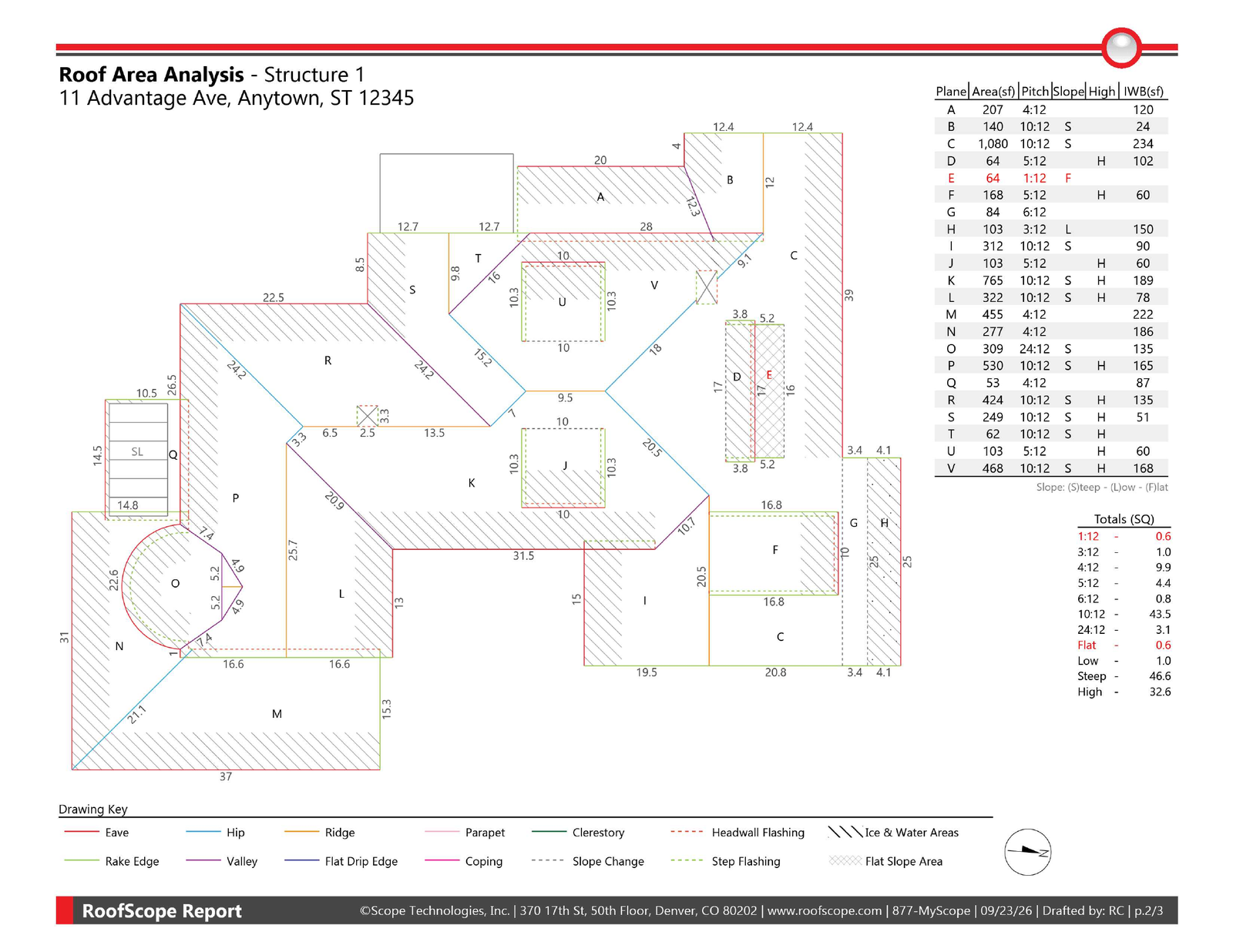
The sample report below draws each of these on the roof diagram, color-coded by type.
Why does one waste percentage miss?
Shingles and accessories waste in different ways. Shingle waste comes from cuts, and it climbs with every hip, valley, and dormer. Linear accessories lose a little at the end of each run, and a lot more at the purchase unit. You can't buy 6.3 bundles of starter. You buy 7.
So a percentage set for shingle cuts gets applied to materials whose waste has little to do with how cut up the roof is. On some lines it adds more than you need. On others, rounding has already done the job before the percentage lands.
One real roof, converted line by line
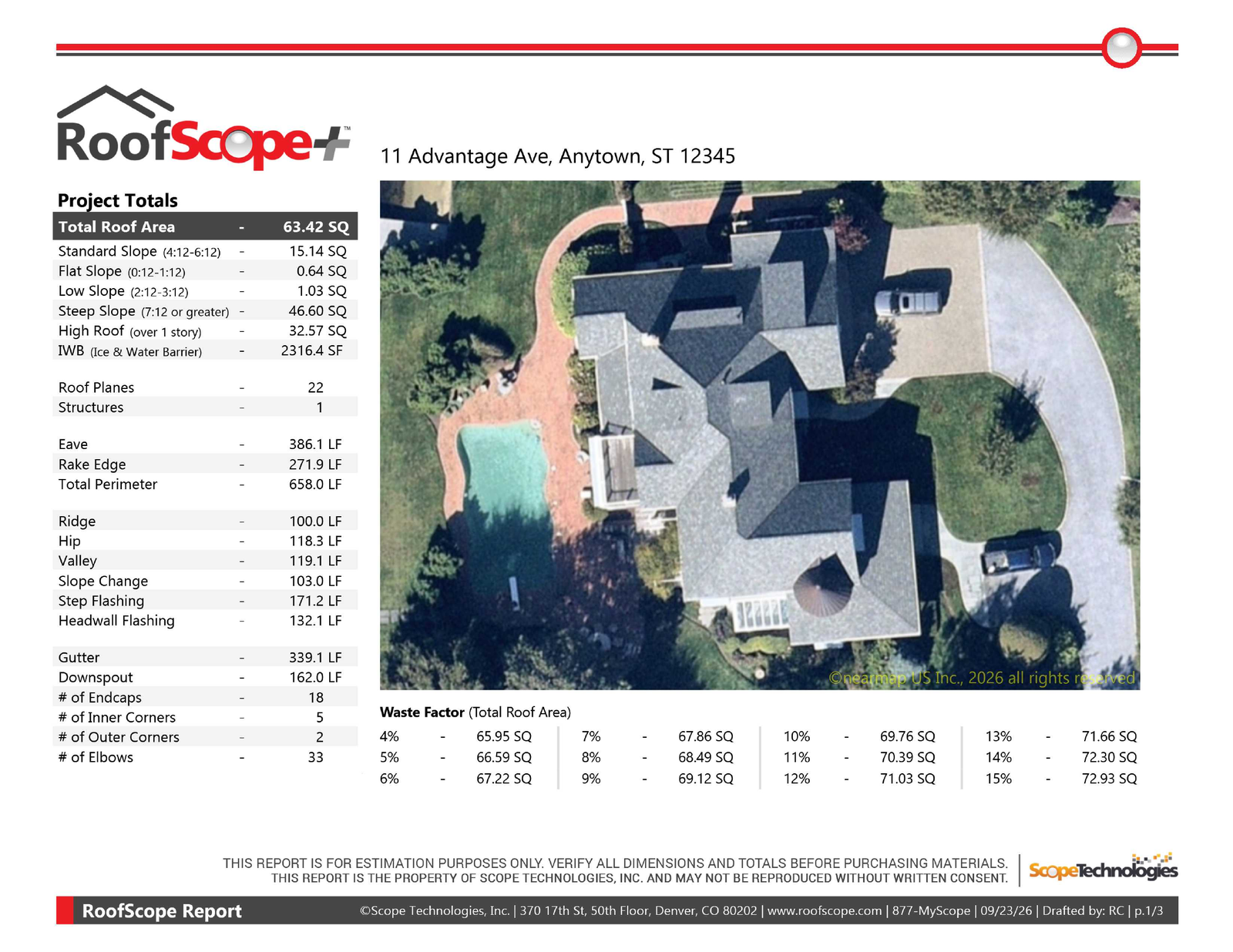
Our sample RoofScope+ report for 11 Advantage Ave covers 63.42 squares across 22 planes, with most of the area at 10:12. We took the report's measurements and ran them through the default conversions above, once with no waste and once with a flat 10%.
| Line item | Measured | Order with no waste | Order with 10% waste |
|---|---|---|---|
| Shingles | 62.78 SQ (63.42 total minus 0.64 flat) | 189 bundles (+0.4%) | 208 bundles (+10.4%) |
| Starter strip | 658.0 LF (eave + rake) | 7 bundles (+11.7%) | 7 bundles (+11.7%) |
| Hip and ridge cap | 218.3 LF | 7 bundles (+5.8%) | 8 bundles (+20.9%) |
| Eave drip edge | 386.1 LF | 39 sticks (+1.0%) | 43 sticks (+11.4%) |
| Rake drip edge | 271.9 LF | 28 pieces (+3.0%) | 30 pieces (+10.3%) |
| Step flashing | 171.2 LF | 6 bundles (+5.1%) | 7 bundles (+22.7%) |
| L flashing | 132.1 LF | 14 pieces (+6.0%) | 15 pieces (+13.6%) |
| Valley W flashing | 119.1 LF | 12 sticks (+0.8%) | 14 sticks (+17.5%) |
| Ridge vent, 30 LF rolls | 100.0 LF | 4 rolls (+20.0%) | 4 rolls (+20.0%) |
| Ice and water barrier | 2,316.4 SF | 12 rolls (+3.6%) | 13 rolls (+12.2%) |
Percentages show how far the ordered quantity lands over the measured quantity after rounding up to whole units.
Rounding is a waste factor you didn't choose
Before any waste factor, rounding alone puts this order between 0.4% and 20.0% over what was measured, depending on the line. Ridge vent shows how much the package decides: on 30 LF rolls, rounding adds 20.0%. On 20 LF rolls, it adds nothing, because 100 feet of ridge is exactly five rolls.
Now add the flat 10%. It lands anywhere from 10.3% to 22.7% over measured. On starter and ridge vent, it changes nothing, because rounding had already covered it. On hip and ridge cap and step flashing, the order ends up more than 20% over.
Some of that may be waste you want. Step flashing on a roof with 171 feet of wall line isn't the place to come up short. Either way, it should be a choice you make per line, not a side effect of a number set for shingles.
What to check before you place the order
- Order a report with edge measurements. RoofScopeX gives total squares and a pitch breakdown, which is enough to qualify a job. The full RoofScope report adds eave, rake, ridge, hip, valley, and flashing lengths. Here's what each RoofScope report includes.
- Take flat area out of the shingle count. Shingles and felt are sized from sloped area. Flat sections need their own materials.
- Size each line from its own measurement. Use the table above as the map.
- Set waste per line. A cut-up roof may need more than your default on shingles. Long, straight runs of drip edge may need very little.
- Confirm packaging with your supplier. Bundle coverage, roll length, and stick length change the math.
- Round on purpose. Know which lines rounding already covers before you add waste on top.
- Verify before you buy. Every RoofScope report carries the same line: "Verify all dimensions and totals before purchasing materials." Use the report to build the order, then check anything the job gives you reason to question.
Where ProDocs fits
If you build orders in ProDocs, each line on a material purchase order can pull its quantity from the specific report measurement that sizes it: eaves for drip edge, hip and ridge for cap, and so on. You set the waste factor on each line individually, along with its conversion, and choose whether to round up to whole units. ProDocs does the math from there. The measurements behind each line come from a RoofScope report backed by a 99% accuracy guarantee. ProDocs is available on eligible RoofScope memberships.
Size each line from the measurement that drives it, and start from a report that gives you all of them.
See a sample RoofScope reportwritten by RoofScope published on 09. 24. 2026